Propital · Scaling a Chilean real-estate investment platform from zero to multi-product
Led the technical foundation of a real-estate investment product covering the full investment lifecycle, from lead to payment, with brokers, contracts, multi-tenant RBAC, and AI-native engineering standards.
The setup
I joined Propital when the company had no Slack, no documentation, and a handful of disjointed tools. Two years later it's a multi-platform real-estate investment product covering the complete investor journey for Chile, with brokers, contracts, team hierarchies and multi-tenant RBAC on top.
As the tech lead, my job was not only to ship features. It was to build the intellectual base of the engineering org: the monorepo, the gitflow, the review rituals, the deploy pipelines, the feature-flag strategy, and the documentation that lets a team of developers work in parallel without stepping on each other.
What I actually built
- The monorepo that holds everything. APIs, services, multiple frontends, back-office, brokers platform, fractional investment. All in one coordinated codebase. Branch strategy, release trains, PR templates, GitHub Actions pipelines, code-owners per domain.
- AI-native engineering standards. Typed repo-wide rules, an automated code-review agent with LLM scoring, structured docs, formalized domain boundaries. The consolidation let the team sustain the original scope with a significantly smaller headcount.
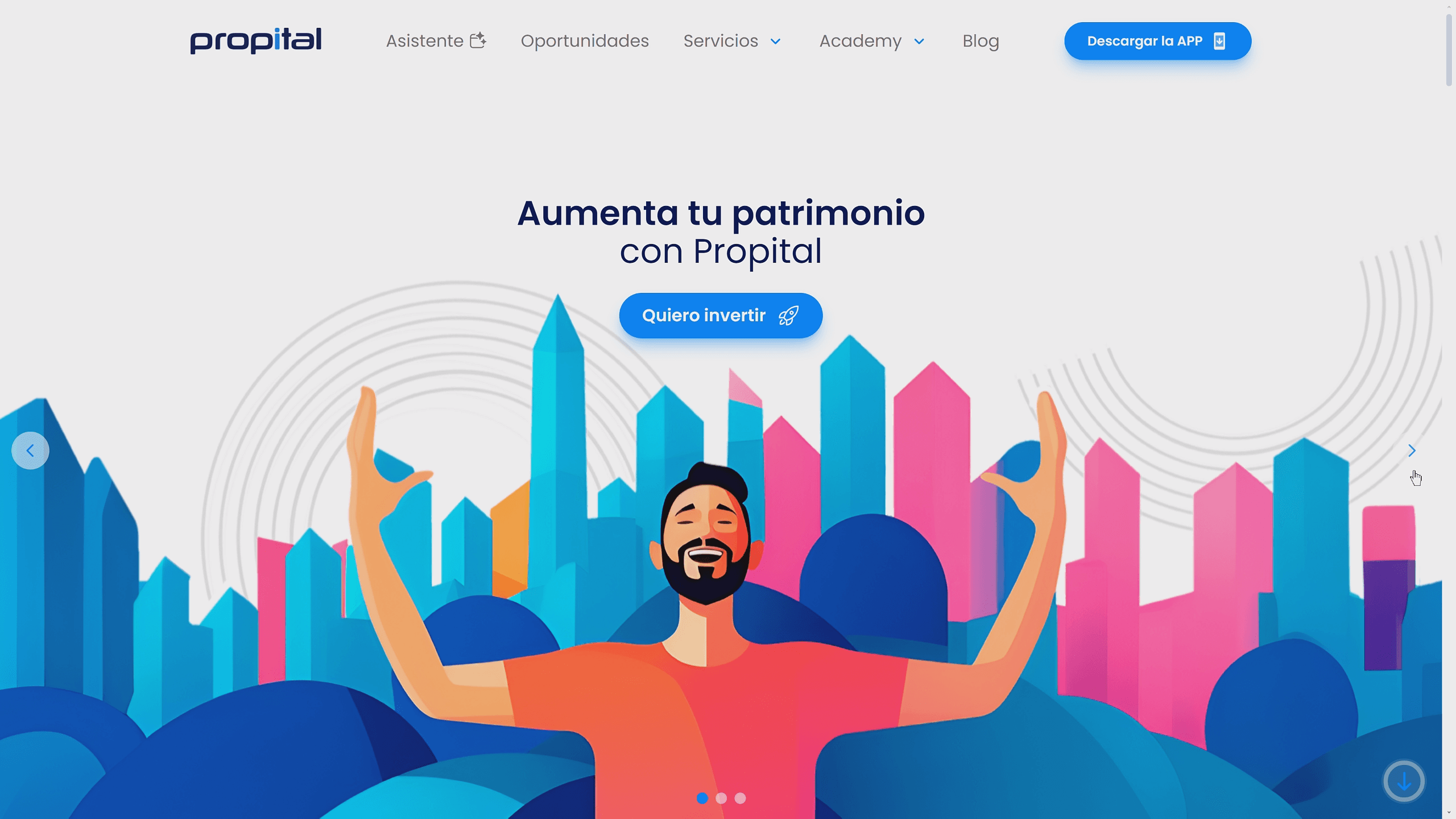
- A redesigned landing page. Not a tweak. A ground-up rebuild with new sections, animations and narrative. The video case study shows the before and after.
- The investment app. Property browsing with Leaflet maps, lead capture, profiling, proposal generation, mortgage simulations, reservation flow, operations and payment integration.
- A back-office for operations, CRM-style leads and customer management, and reporting. The ERP layer that runs the business.
- A brokers platform with contracts, team leaders, hierarchies and revenue splits. Each broker organization is a tenant with its own RBAC.
- A fractional investment product (fraccionario.propital.com). Public-facing, letting investors buy slices of properties.
- AWS infrastructure. Amplify for the frontends, Lambda for event-driven workloads, S3 for assets and documents, Cognito for identity across tenants.
Hard problems, chosen tradeoffs
Multi-tenant with wide RBAC. Brokers are tenants. Inside a broker, there are team leaders, mid-level operators, individual brokers. Customers have their own role set. A feature the broker-leader sees is not the same one the individual broker sees, and neither matches the customer app. I built the RBAC layer as a composable policy system so product could introduce new roles without engineering digging into auth every time.
Feature flags for parallel development. With multiple long-lived feature branches, feature flags became the only way to keep main deployable. I introduced a typed flag system that lives in a single source of truth and ships safely to any tenant, with flag rollout per broker.
Documentation as a first-class artifact. I documented the monorepo top to bottom: API contracts, service boundaries, front-end component library, onboarding paths, the full RBAC system, database schema references, formalized business domains with C4 diagrams. That's the single biggest reason a new dev gets productive in days, not months.
AI tooling as leverage, not decoration. The automated PR reviewer, the typed Cursor rules, the agent-readable documentation structure. They are not window dressing. They are what lets a small team maintain the same scope as a much larger one.
What I'm most proud of
The company went from "no Slack" to running a full CRM, ERP, brokers platform and public apps, and the engineering org went from ad-hoc to disciplined in the same window. The code is private, but the scaffolding is something I'd ship anywhere.
Artifacts
- Live landing page
- Public fractional investment product
- Landing redesign video. Before and after.